Why website redesigns, smarter architecture, and genuine expertise matter more in the age of AI search.
For years, we’ve heard that websites are becoming less important.
Social media was taking over. Apps were replacing websites. Everything was moving toward feeds, short-form videos, and platforms where brands could reach customers without anyone ever visiting their homepage.
And now AI is changing search.
So does that mean websites matter even less?
I actually think the opposite.
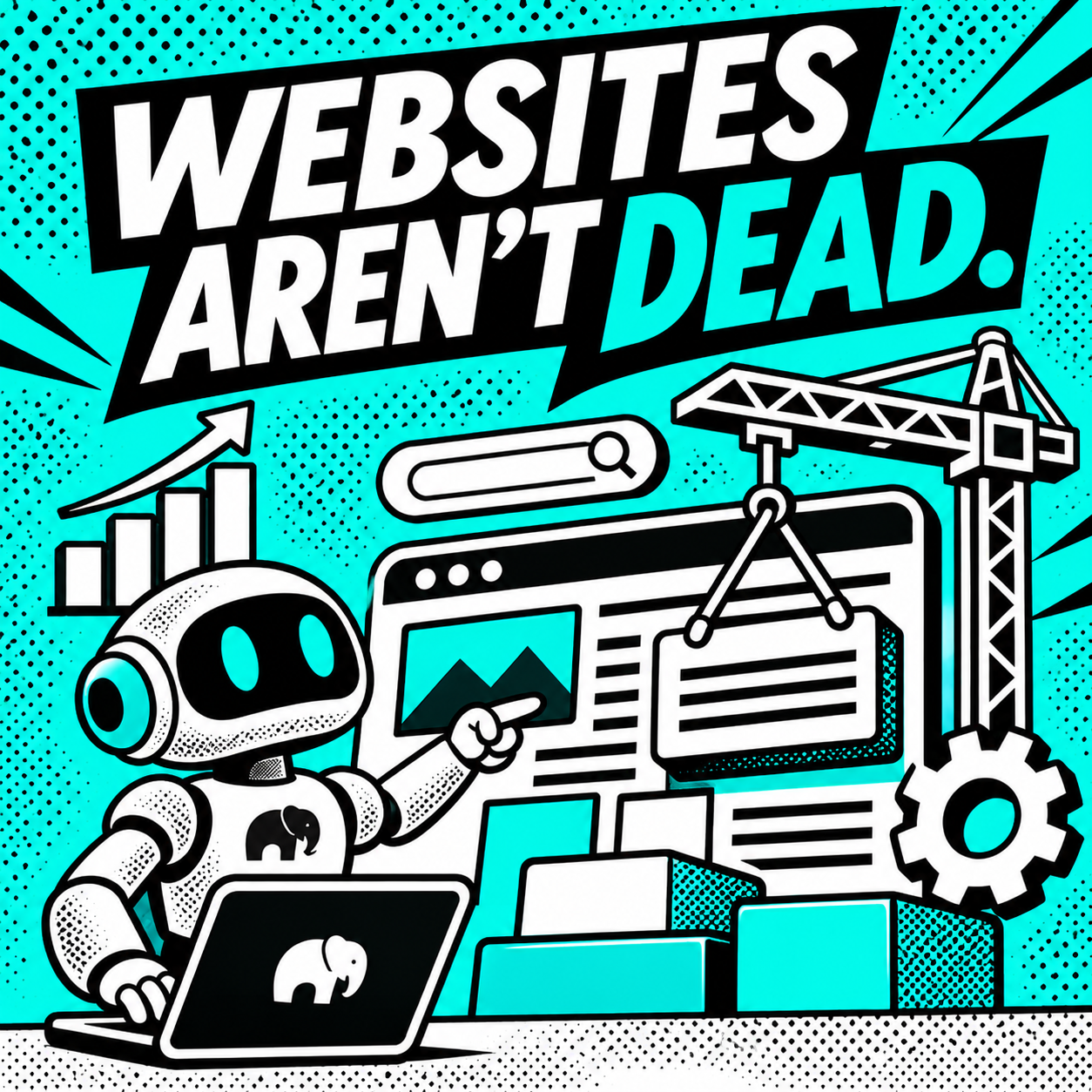
The website isn’t dead. But the way we build one needs to evolve.
A beautiful website isn’t enough anymore.
At Elefantly, we’ve been designing, developing, and optimizing websites for years. And while the tools have changed, one thing hasn’t: a good website needs to do more than look impressive.
It needs to communicate what a business does, who it serves, what it knows, and why someone should trust it.
Traditionally, much of that work was about Google. We researched keywords, organized pages, wrote titles and descriptions, improved site speed, and made sure search engines could crawl and index everything properly.
We still do those things.
But now there’s another consideration.
When someone asks ChatGPT, Google AI Mode, Gemini, or Perplexity about a product, service, or industry, is your brand part of the information those systems can discover and use?
And if it is, are they understanding your business correctly?
Your website is an organized body of knowledge.
Here’s where I think a lot of businesses are missing an opportunity.
A website shouldn’t just be a homepage, an About page, and a handful of services.
It can be a carefully organized collection of expertise.
Think about a cybersecurity company specializing in secure communications.
Instead of having one generic page about security, it might benefit from dedicated pages explaining secure business messaging, encrypted communications, WhatsApp-related risks, enterprise privacy requirements, and the specific problems its products solve.
Then you connect those pages with genuinely useful articles, clear navigation, and relevant internal links.
Each page has a purpose. Each article answers a real question. And together, they create a more complete picture of the company’s expertise.
This is the kind of work we’re doing with clients like DeepView: developing more focused pages and expanding educational content around secure communications.
It’s not about publishing as many pages as possible.
It’s about making the website a better resource on the subjects the business actually understands.
Sometimes a redesign isn’t enough. You need a restructure.
This is why I think website revamps deserve another look in the AI era.
A company might have a beautiful site, but its most important expertise is buried in generic pages. Its navigation doesn’t reflect what customers are looking for. Its content is scattered. Or its technical setup makes important information harder to access.
Changing the colors and fonts won’t solve those problems.
Sometimes we need to rethink the architecture.
Which topics deserve dedicated pages? How should services and products be grouped? What questions are customers asking? How should content connect? Can search engines and other authorized crawlers access the information reliably?
And importantly, what happens when someone actually lands on the website?
Because discoverability without a good user experience doesn’t accomplish much.
AI search isn’t traditional SEO with a new name.
Different AI systems retrieve and use information in different ways. Some rely on search indexes, some retrieve live web pages, and some use other sources or previously learned information.
There’s no magic code snippet that guarantees your business will be recommended.
But accessible content, sound technical foundations, accurate structured information, useful expertise, and clear site architecture remain sensible investments.
And they serve real customers, too.
That last part matters.
We shouldn’t be building websites for AI at the expense of people. We should be building better websites for both.
Authority isn’t claimed. It’s built.
You can’t simply add the word “expert” to your homepage and expect search engines or AI assistants to believe it.
Authority comes from doing the work.
Explaining your subject clearly. Publishing original insights. Demonstrating experience. Keeping information accurate. Earning relevant recognition. And connecting that knowledge through a website people can actually navigate and understand.
That’s the thinking behind our Authority Engine™ methodology at LFNTLY.
It’s not a shortcut or an automated promise of AI rankings.
It’s an approach that brings website development, technical SEO, content strategy, discoverability, and measurement together.
Should you rebuild your website?
Not necessarily.
Some websites need a complete rethink. Others need better content architecture, stronger service pages, improved technical SEO, or a more focused editorial strategy.
And sometimes the existing site is already a solid foundation.
The important thing is to assess it through today’s discovery landscape rather than assuming the same structure will serve the business forever.
We recently wrote about Google’s dramatic market-value drop and what the changing search landscape means for brands.
That was about the shift.
This is about what we do next.
At Elefantly, we’re bringing years of website design and development experience together with SEO, AI discovery, and eCommerce strategy through LFNTLY Commerce.
Because while the way people discover businesses is changing, the need for credible, useful, well-built websites hasn’t gone away.
Build something worth finding. Then make it easier to find.