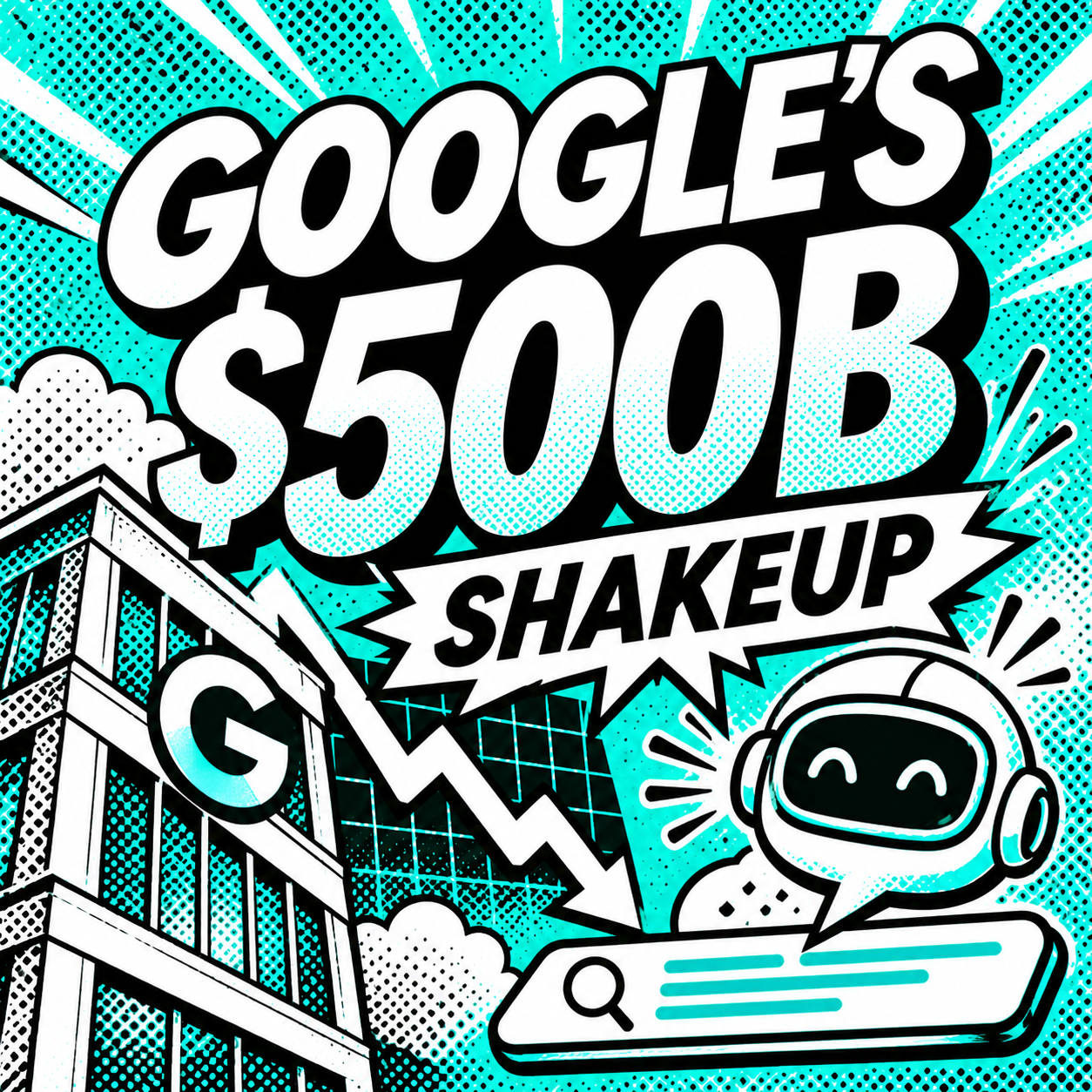
Google just lost roughly $500 billion in market value in a single day.
Yes, billion. With a B.
When I saw that headline last week, my first thought wasn’t about Google’s stock price. It was about all the businesses that have spent years building their websites, optimizing their content, and investing in Google to bring customers through the door.
Because something pretty significant is happening to search right now.
And I don’t think enough businesses realize how much it’s changing.
First, what actually happened?
On October 29, Google’s parent company, Alphabet, suffered a historic stock-market decline following its quarterly earnings announcement.
Google isn’t going bankrupt. Far from it.
The company still generated $127.6 billion in quarterly revenue, up 25% from a year earlier. Its search business is still enormous, and Google Cloud is growing rapidly.
But investors weren’t particularly impressed.
Search advertising growth came in below expectations. AI infrastructure spending is massive. And perhaps most interestingly, Google’s own AI search experience is creating a new challenge for the business model that made Google one of the most valuable companies in the world.
Think about that for a second.
Google is investing billions into technology that’s changing the way people use Google.
And the financial implications are starting to become visible.
The Google search experience is changing
For years, the formula was pretty straightforward.
Someone searched Google. Google displayed results. People clicked websites. Businesses competed to appear near the top.
SEO was about helping those businesses get discovered.
Of course, it was never quite that simple, but you get the idea.
Now, someone can ask a question and receive an AI-generated answer before ever visiting a website.
They might compare products, research a brand, or ask for a recommendation without following the same path through traditional search results.
Google’s AI Mode is part of that shift. So are ChatGPT, Gemini, Claude, Perplexity, and other AI-powered discovery experiences.
And here’s the interesting part: Google has acknowledged that searches in AI Mode currently generate less advertising revenue than traditional search.
That’s a pretty remarkable admission from a company whose advertising business has helped shape the internet for more than two decades.
Your website might still rank. But is it being recommended?
This is the question I’ve been thinking about most lately.
I’ve worked on SEO, website development, UX, and eCommerce for years. I’ve watched Google change its algorithms, introduce new search features, and shift the rules more times than I can count.
Usually, the conversation is about rankings.
Are we on page one? Are we getting more organic traffic? Which keywords are performing?
Those questions still matter.
But I think we need to start asking another one.
When someone asks AI to recommend a company like yours, does your brand even come up?
And if it does, is the information accurate?
Does the answer understand what you sell, what makes you different, and why someone should choose you?
A beautiful website doesn’t automatically solve that problem.
Neither does publishing hundreds of blog posts.
Traditional SEO isn’t dead. It’s becoming part of something bigger.
I want to be clear about this because there are plenty of dramatic headlines declaring SEO dead every time Google changes something.
I don’t believe that.
Technical SEO still matters. Good content still matters. Fast, accessible websites still matter. And Google remains an incredibly important source of discovery.
What is changing is how all those pieces work together.
Your brand now needs to be understandable not only to traditional search engines, but also to systems that summarize, compare, and recommend information.
That means thinking beyond keywords.
It means making your products, expertise, brand identity, and supporting information clear and consistent.
It also means understanding that visibility doesn’t always translate directly into a website visit.
Sometimes the first interaction with your business happens inside an AI-generated answer.
What should businesses actually do?
I wouldn’t recommend panicking or throwing away your existing SEO strategy.
I’d start by looking at a few fundamentals.
Make sure your website is technically sound. If search engines struggle to crawl, interpret, or understand your content, that’s a problem worth fixing regardless of AI.
Explain what you do clearly. Not just with clever headlines, but with meaningful information about your products, services, expertise, and the people behind the business.
Strengthen your authority. Relevant coverage, credible mentions, useful content, and a consistent brand presence help establish who you are. None guarantees an AI recommendation, but they’re sensible foundations.
Pay attention to product information. For eCommerce businesses, accurate descriptions, structured data, availability, and clear product details are increasingly important.
Don’t forget conversion. Being discovered is only part of the equation. When someone finally arrives at your website, the experience needs to make sense.
And finally, start testing.
Ask different AI platforms about your industry, products, or services. Look at which companies appear and how they’re described.
You may discover that the competition for visibility looks quite different from the traditional Google results you’re used to.
What Google’s $500 billion day really tells us
I don’t see this as the end of Google.
I see it as a sign of how complicated the transition to AI-powered search has become, even for the company that dominates traditional search.
Google is trying to protect an extraordinarily successful advertising business while simultaneously changing the experience that supports it.
That’s a difficult balancing act.
For businesses, the lesson isn’t to abandon Google or chase every new AI platform that appears.
It’s to recognize that the way customers discover brands is expanding.
And your digital strategy needs to expand with it.
At Elefantly, that’s exactly why we’ve been developing our approach to AI visibility alongside the SEO, eCommerce, and UX work we’ve been doing for years.
We’re looking at how brands are found, how they’re understood, and ultimately how they’re chosen.
Because being online isn’t enough anymore.
Being discovered is everything.
Curious how your brand appears across AI-powered search?
Explore our LFNTLY Commerce AI Visibility Audit and start understanding how customers might discover your business next.